Activities
08 Sep 2025
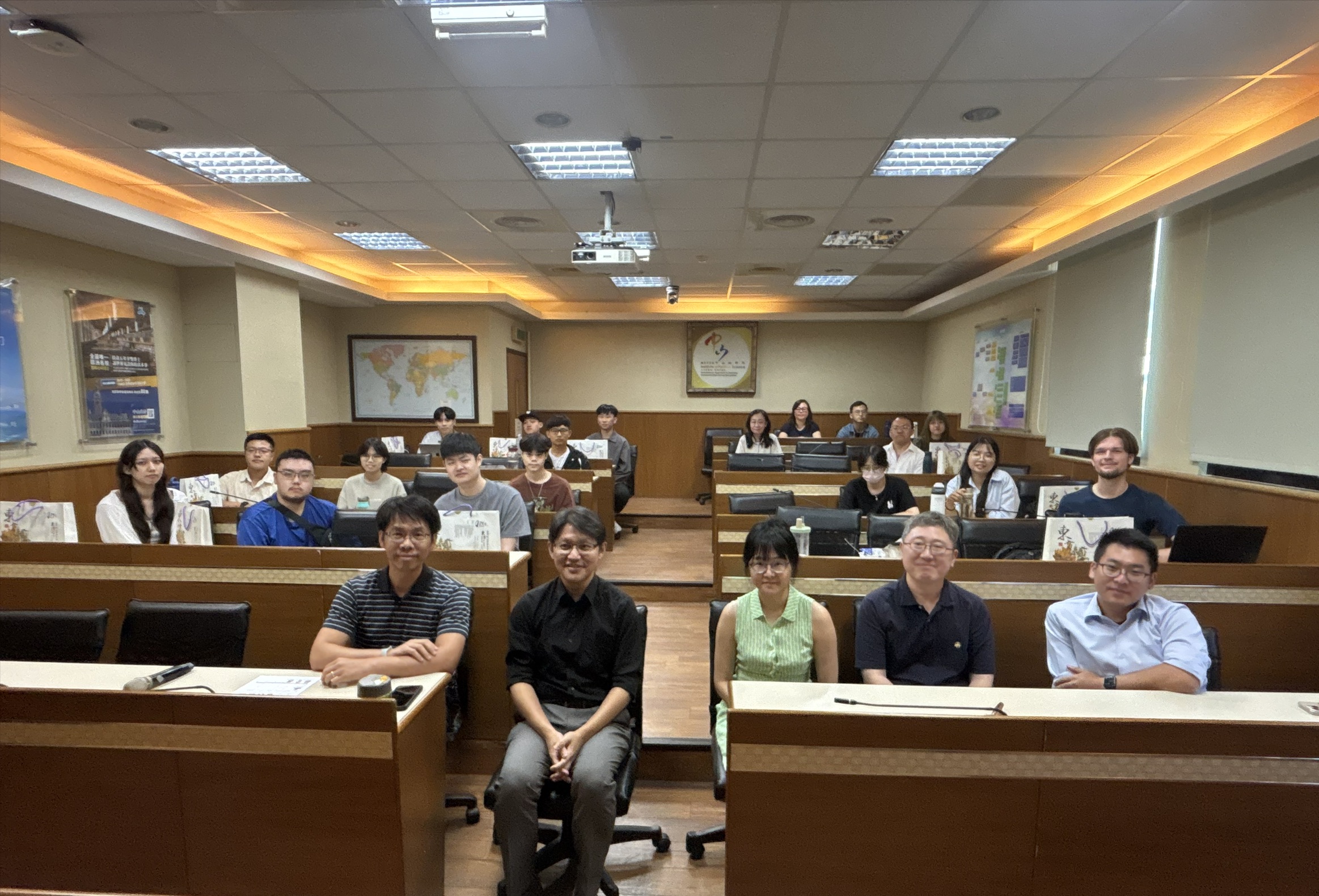
2025 NSYSU Political Science — Grad Orientation Day
WELCOME ON BOARD!
NSYSU Political Science — Grad Orientation Day
It’s the first day of school and our welcome ceremony for new MA students—
friends from all kinds of backgrounds are officially part of the NSYSU PoliSci family!
We may be a small department, but we’ve got professors covering the whole intellectual map.
Think “mini but mighty”—from theory to methods to real-world politics.
Fun fact: we’ve got classmates who play the guzheng, and profs who are anime fans.
And seniors are already sharing Shoushan macaque survival tips:
Our campus monkeys are picky eaters.
When you walk around, bring the plainest paper bag you can find.
Fast-food bags = public enemy #1 (you’ve been warned).
Who is grad school for? Two kinds of people:
Smart folks who want to get smarter, and
Very smart
02 Jun 2025
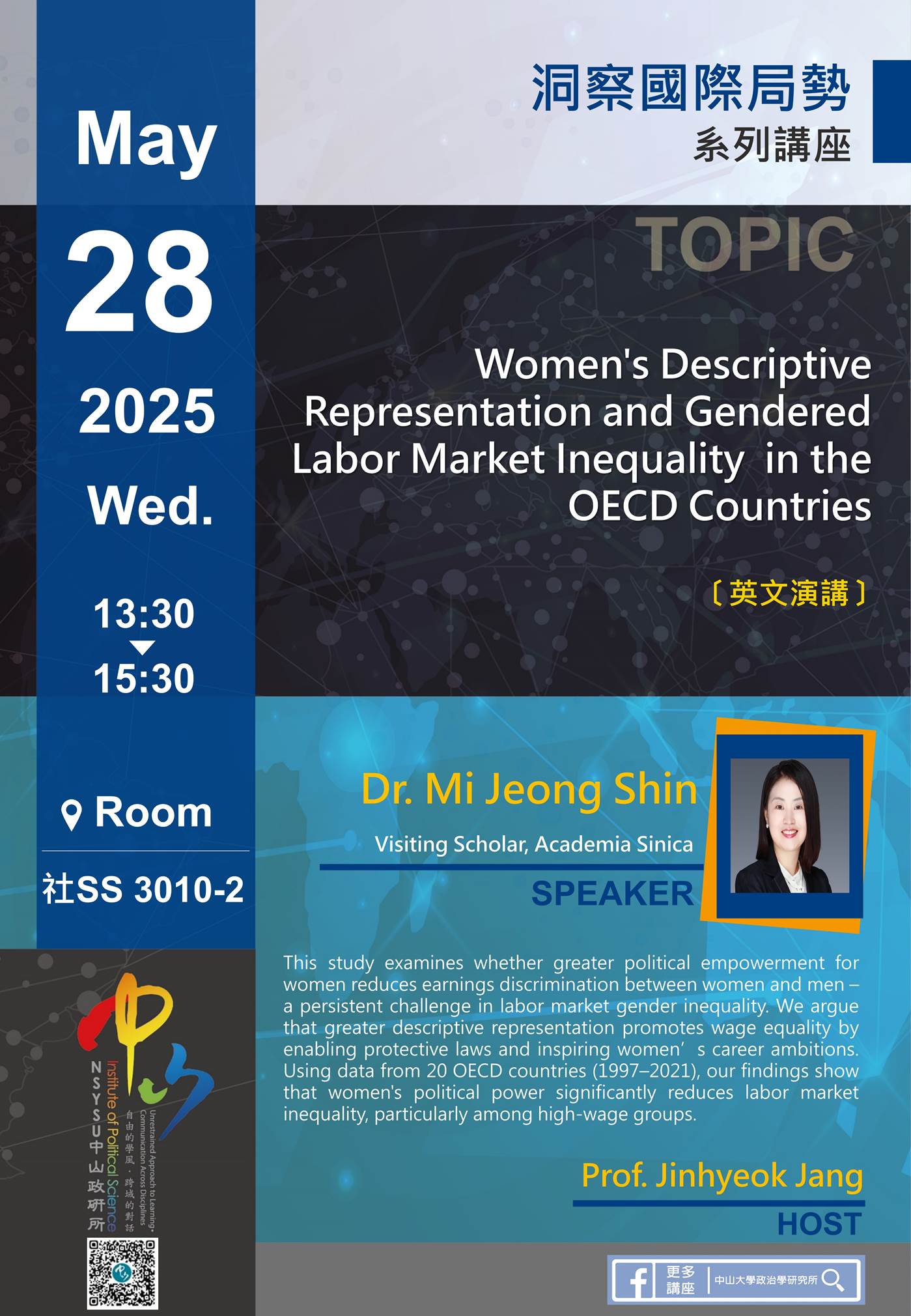
Dr. Mi Jeong Shin:Women's Descriptive Representation and Gendered Labor Market Inequality in the OECD Countries
Our institute will be hosting a lecture as part of the "Insights into International Affairs" series. The details are as follows:
Topic:
Women's Descriptive Representation and Gendered Labor Market Inequality in the OECD Countries
Speaker:
Dr. Mi Jeong Shin (Visiting Scholar, Academia Sinica)
Date & Time:
Wednesday, May 28, 2025, 13:30–15:30
Venue:
Lecture Hall, Institute of Political Science (Social Sciences Building, Room SS 3010-2)
Language:
English
Highlights:
This study examines whether greater political empowerment for women reduces earnings discrimination between women and men—a persistent challenge in labor market gender inequality. We argue that greater descriptive representation promotes wage equality by enabling protective laws and inspiring women’s career ambitions. Using
29 Apr 2025

Marc Lanteigne: Cold Realities: The Transformation of Arctic Security and Great Power Competition
It has been widely accepted that the post-cold war era of Arctic security is ending, but there is much debate over what will follow. Climate change continues to be the dominant security threat to the far north, but the melting ice has also led to the risk of greater geopolitical disputes over resources, access, and potentially over lands. The main reason behind these changes is the reassertion of zero-sum political thinking in the Arctic, especially by great powers. At the same time, non-Arctic states, including China, are also seeking a louder voice in regional affairs, leading to fears of a balkanized Arctic and a clouded future for regional diplomacy
25 Apr 2025

Nick C. N. Lin:Inter-party Cooperation and Affective Polarization: Evidence from a Quasi-natural Experiment in Taiwan
This paper examines whether elite cooperation can reduce affective polarization in real-world settings. Leveraging a rare legislative alliance between Taiwan’s Kuomintang and Taiwan People’s Party in 2024, we conducted two repeated conjoint experiments before and after the alliance. Results show that this cooperation reduced inter-partisan hostility and improved social interactions among their supporters, offering new insights into how elite behavior shapes partisan divisions in polarized democracies.
25 Dec 2024
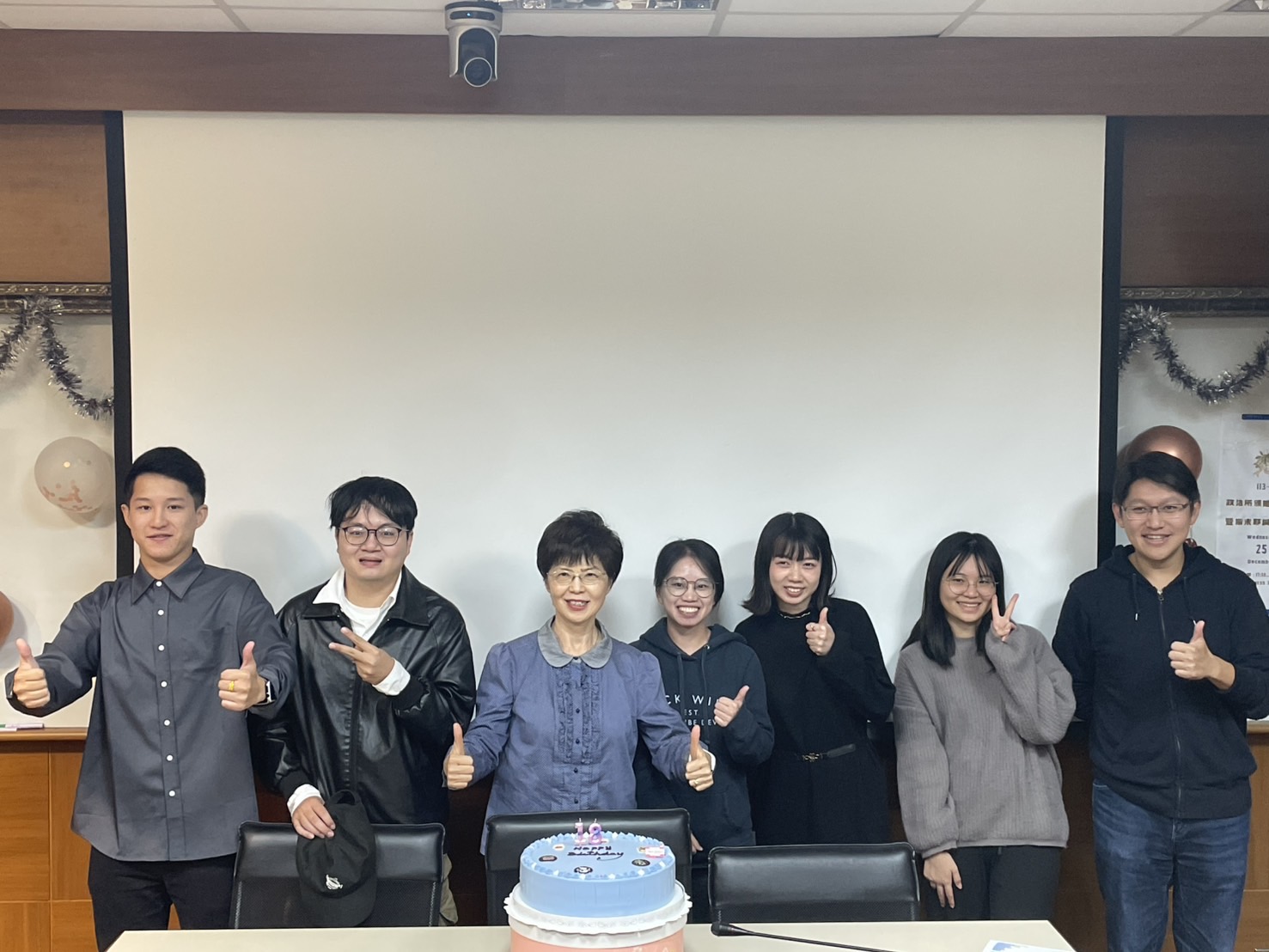
【Merry Christmas:】2024 IPS Christmas Celebration and Birthday Party
Another year has passed peacefully! Thank you to everyone in the Department of Political Science at NSYSU for your hard work!
30 Jan 2024
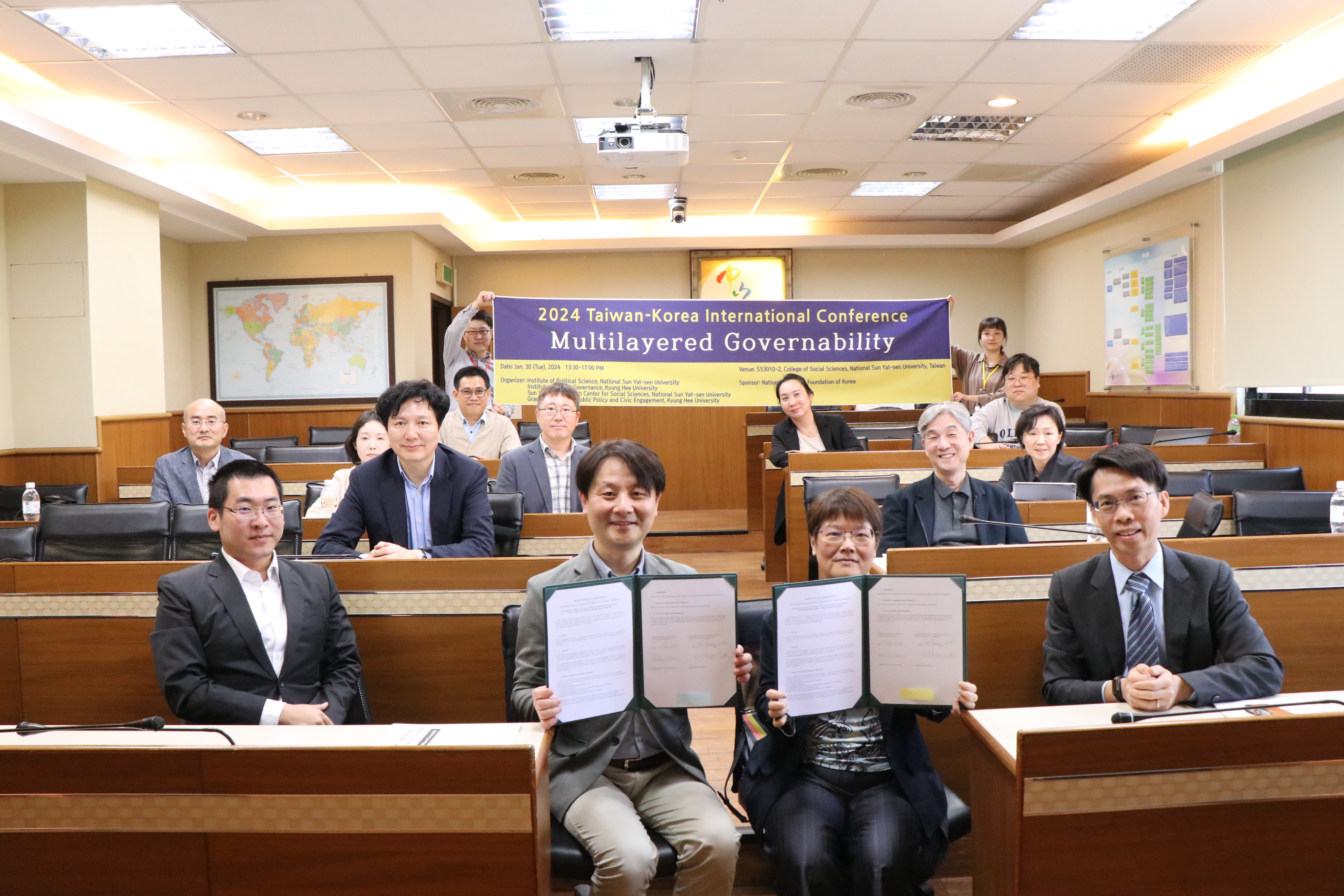
International Conference on Multilayered Governability(Institute of Political Science at NSYSU X Institute of Public Governance at KHU)
The Graduate School of Public Policy & Civic Engagement at Kyung Hee University in South Korea visited Sun Yat-sen University on January 30. They signed a dedicated academic exchange agreement with the College of Social Sciences at Sun Yat-sen University in the auditorium of the Institute of Political Science to promote international cooperation
28 Nov 2024
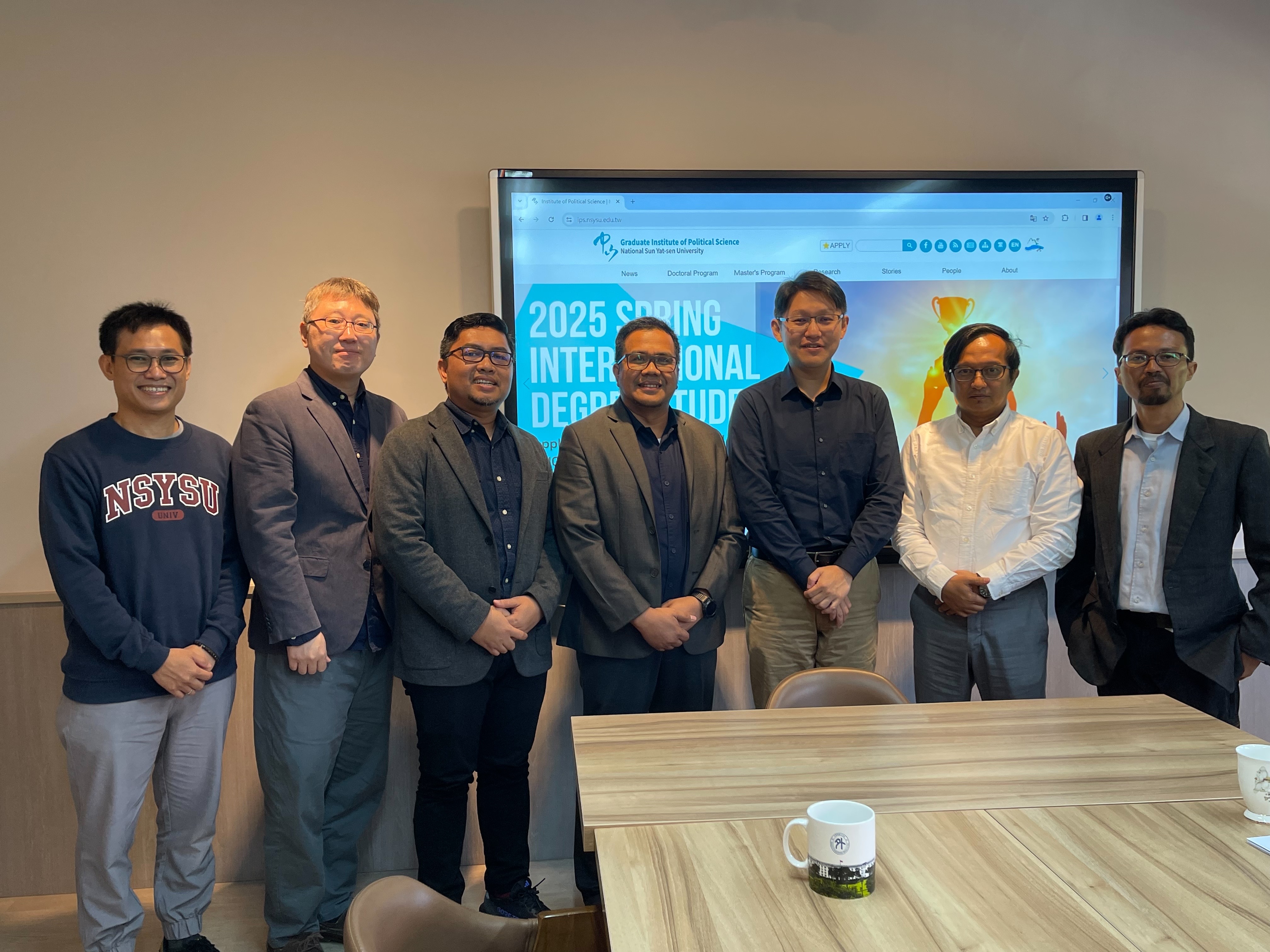
Visit of the Universitas Andalas International Relations Delegation from Indonesia
On November 28, 2024, the Institute of Political Science (IPS) welcomed a delegation from the Department of International Relations, Universitas Andalas, Indonesia. The delegation was led by the department's chairman, Dr. Apriwan, accompanied by the department secretary, Dr. Muhammad Yusra, and faculty members Dr. Virtuous Setyaka and Dr. Zulkifli Harza.
26 Nov 2024
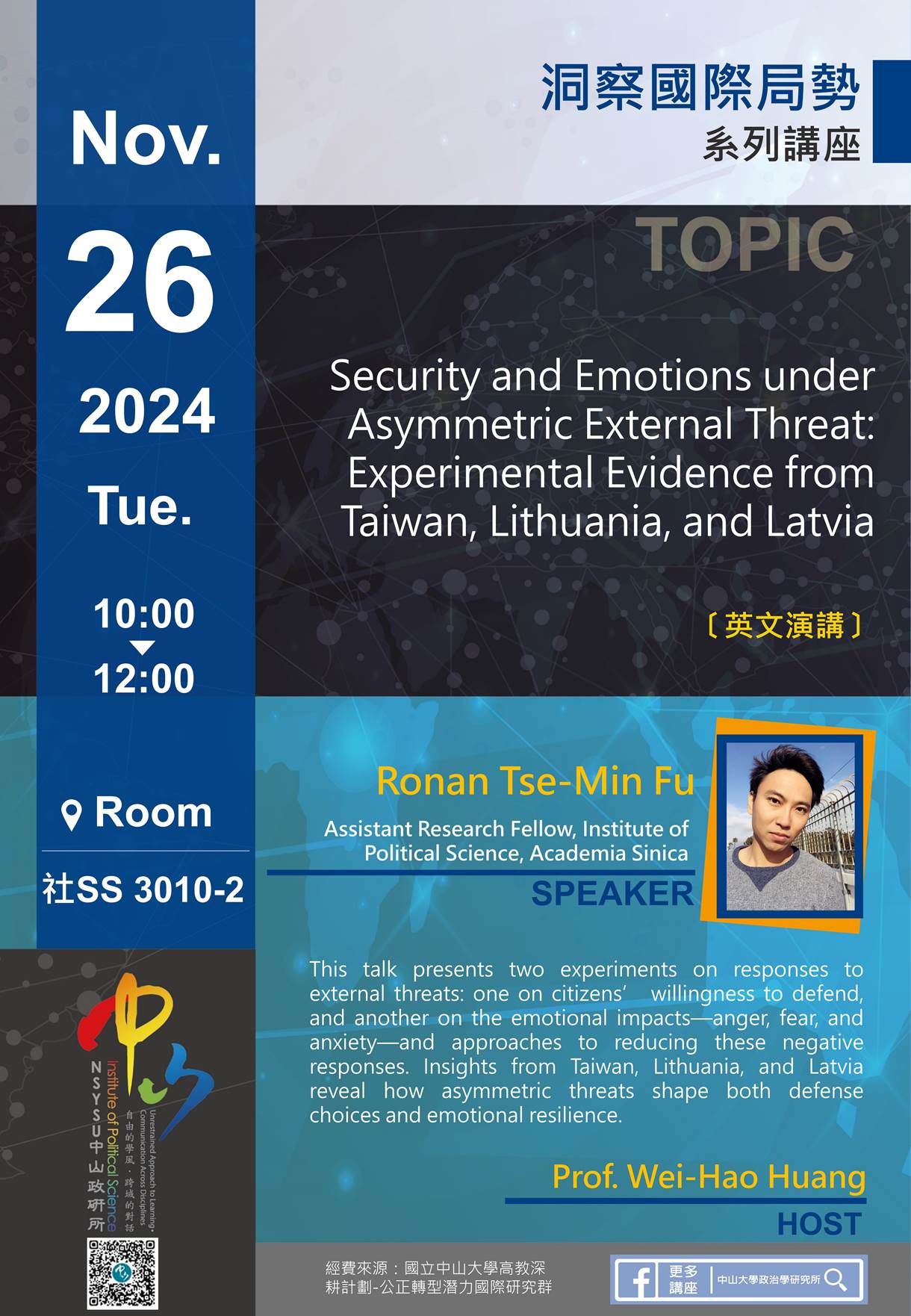
Ronan Tse-Min Fu:Security and Emotions under Asymmetric External Threat: Experimental Evidence from Taiwan, Lithuania, and Latvia
This talk presents two experiments on responses to external threats: one on citizens’ willingness to defend, and another on the emotional impacts—anger, fear, and anxiety—and approaches to reducing these negative responses. Insights from Taiwan, Lithuania, and Latvia reveal how asymmetric threats shape both defense choices and emotional resilience.
04 Jun 2024
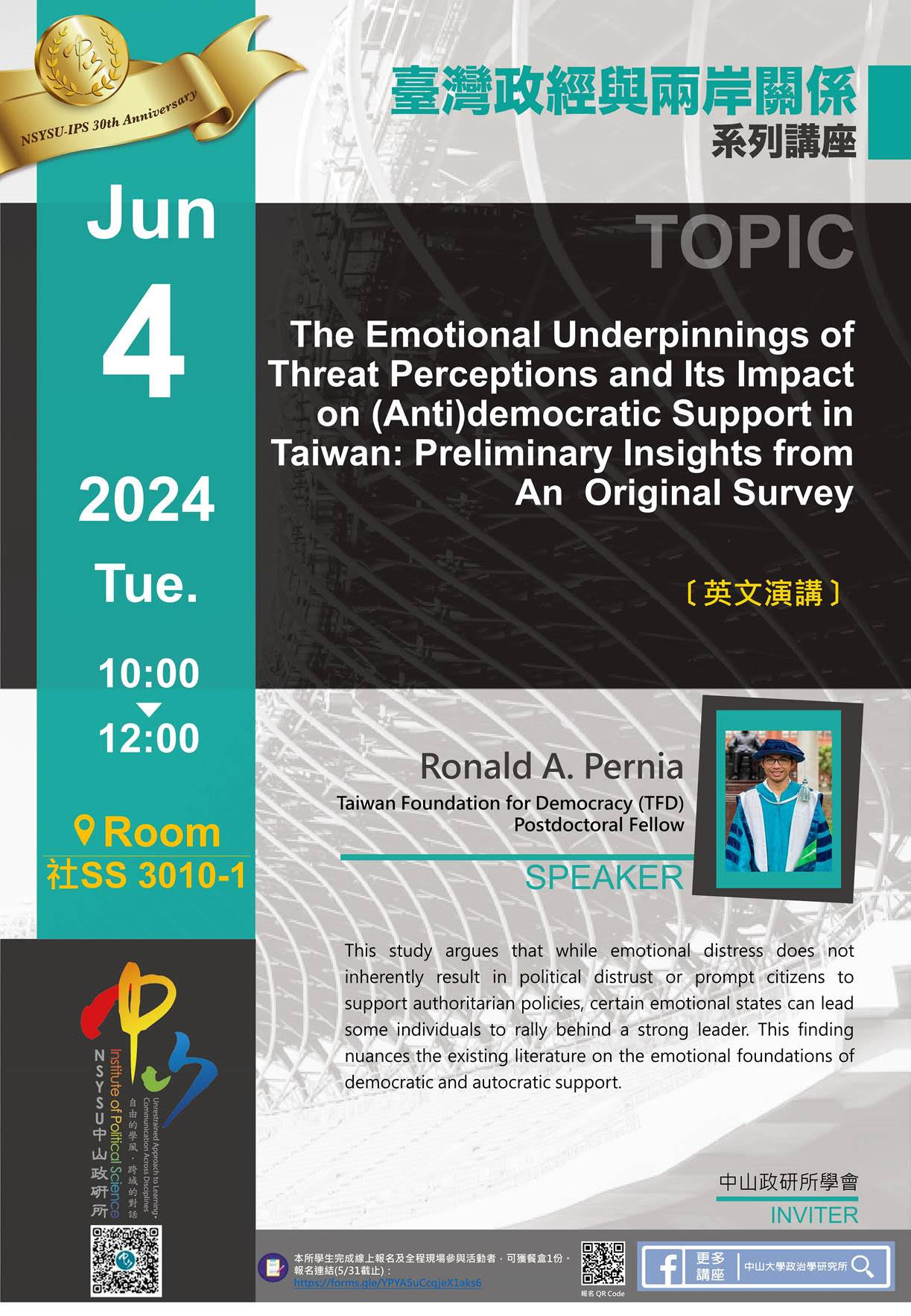
Ronald A. Pernia:The Emotional Underpinnings of Threat Perceptions and Its Impact on (Anti)democratic Support in Taiwan: Preliminary Insights from An Original Survey
This study argues that while emotional distress does not inherently result in political distrust or prompt citizens to support authoritarian policies, certain emotional states can lead some individuals to rally behind a strong leader. This finding nuances the existing literature on the emotional foundations of democratic and autocratic support.